

Compact Remote IO solutions for innovative Ex projects
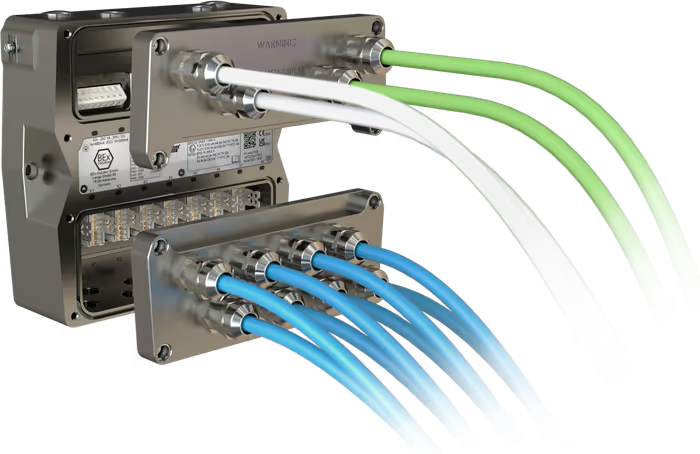
Significantly reduce your E/I&C engineering and installation effort in hazardous areas with the fully Ex-certified and field-proven BEx Remote IO solutions!The Remote IO modules from BEx-Solution were developed specifically for safe and robust use in hazardous areas, Zone 1/21.




Does this sound familiar?
Extensive planning for hazardous areas ties up valuable resources
Too many individual components make errors more likely
Complex installations drive up costs and time
Delays in commissioning and acceptance
Coordination between planning, installation and operation is tedious
Our solution
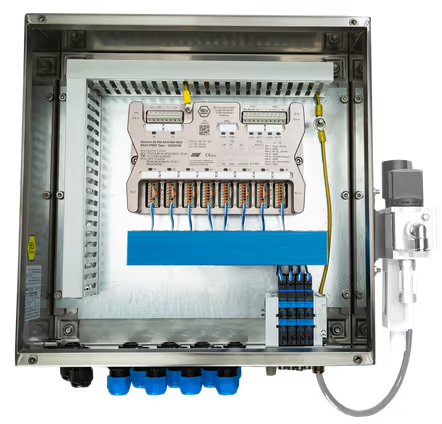
With the BEx1 Remote IO Valve Box, plant and machine builders have for the first time a decentralized, compact system unit with Profinet or Modbus TCP/IP for controlling pneumatic actuators in hazardous areas, Zone 1/21.
Compact – Simple – Fast
Central Ethernet connection to the industrial network (Profinet or Modbus TCP/IP) for error-free transfer of critical data
Central compressed-air connection
Decentralized mounting in the plant - guarantees short distances to the sensors and pneumatic actuators
No compressed-air tubing inside the enclosure
Cost savings and less installation effort
Want to know exactly how the BEx Remote IO Box can reduce your costs and installation effort? We offer support and advise you without obligation – tailored precisely to your needs.
What is Remote IO? A simple explanation
Remote IO (RIO for short) stands for “remote input/output”: decentralized input and output modules in industrial automation. Instead of wiring every sensor and actuator individually all the way to the control cabinet, the signals are collected directly in the field. A Remote IO module bundles them and transmits them to the controller (PLC) over a single bus cable, today usually Ethernet (Profinet or Modbus TCP/IP).
How a Remote IO system works
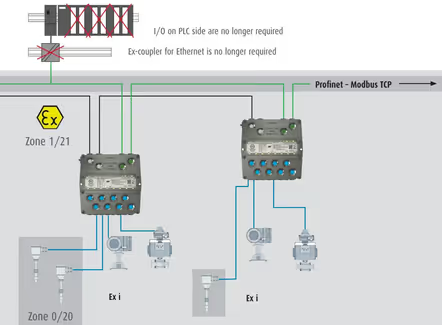
The principle is simple: sensors and actuators are connected with short cables to the nearest Remote IO module. The module converts the analog and digital signals and communicates with the central controller via Profinet or Modbus TCP/IP. Long trunk cables, junction boxes and isolating switch amplifiers are no longer required.
Remote IO in hazardous areas
Remote IO shows its strengths especially in hazardous areas. Ex-certified modules such as the BEx1 IP67 may be mounted directly in Zone 1/21, without an additional Ex enclosure. The intrinsically safe signal circuits (Ex i) are already integrated. This reduces the E/I&C engineering effort by up to 80% and makes the plant clearer, safer and faster to commission.
In short: Remote IO brings the intelligence to where the signals originate: the field. Fewer cables, fewer components, fewer sources of error.
Modular vs. compact Remote IO
Modular Remote IO systems
- Complex and require many individual components
- Increased space requirements
- Dedicated configuration software required
- Advantageous for large plants with high signal density

Compact BEx Remote IO technology
- Simple design, all functions and interfaces integrated in one module
- Very small footprint thanks to the compact form factor
- No dedicated configuration software required
- Ideal for small and medium-sized machines/plants with mixed signal density
Advantages
Up to 80% less E/I&C engineering effort
Up to 50% less installation effort
Higher plant availability and technical reliability in operation
More safety and flexibility in hazardous areas
Why it works
Optimized for E/I&C engineering
Pre-configured, standardized modules
Decentralized architecture reduces complexity
Focus on easy integration and high scalability
About us
We are certified to ISO 9001:2015 and guarantee our customers and partners the highest level of quality and reliability, both for our products and for the processes within our company.
Industry expertise: tailored solutions for your hazardous area project
Plant builders in the chemical, pharmaceutical and oil & gas industries
E/I&C engineers and engineering firms
Operators of systems in hazardous zones
System integrators & automation specialists
Remote IO in practice: three projects from hazardous areas
Three examples of how compact Remote IO modules from BEx-Solution simplify wiring, space requirements and commissioning in hazardous-area plants.
Process cooling system in the hazardous area – LAUDA
In two process cooling systems of the SUK series, the controller sits directly on the unit, in a flameproof Ex d enclosure where every centimeter counts. Instead of connecting the Ex i sensors and positioners via isolating switch amplifiers, a BEx1 module in the Ex e terminal compartment picks up the signals directly and communicates with the SIMATIC ET200SP via Profinet. This frees up the space needed in the enclosure, saves IO cards and cable entries, and also provides the controller with extensive diagnostic data.
Filling line for spray paint cans – MOTIP DUPLI
For the Profinet conversion of a filling line for spray paint cans, digital and analog sensors as well as solenoid valves had to be connected in ATEX Zone 1. The PLC is located outside the zone. Several compact BEx1 Remote IO modules were mounted directly on the production line for this purpose. All signals run to the controller over a single Profinet cable. The sensor cables stay short, the isolating switch amplifiers of the old system are eliminated entirely. Because the modules need no parameterization, the programming effort was limited to the PLC itself.
Airfield refueling vehicle – KAR KUNZ
In the airfield refueling vehicles from KAR KUNZ Aviation Refueling, many digital and analog signals have to communicate with the controller in the driver's cab. Without a bus system, this is only possible with thick trunk cables. NAMUR proximity switches, solenoid valves and differential pressure transmitters are therefore connected over a short distance to the BEx1 IO Box, which communicates directly with the IFM controller via Modbus TCP. Cabling and installation effort drop significantly, and separate Ex isolators are no longer needed because they are already integrated in the box.
Frequently asked questions
In the past, conventionally wired plants were the norm. Today, bus technology and decentralized Remote IO systems have become the industry standard. This greatly reduces cabling effort and saves costs. Compact IO modules in particular allow the system to be distributed across the field. Sensors and actuators in the hazardous area can be connected directly to the BEx module. Isolating switch amplifiers as well as analog and digital IO cards in the safe area are no longer required.
Standard IO cards are installed in the non-hazardous area together with the controller in the control cabinet. If these cards are not intrinsically safe, additional isolating switch amplifiers have to be added. All intrinsically safe signals from the field must be wired laboriously via junction boxes and trunk cables. The BEx Remote IO Boxes are mounted directly in the hazardous area, close to the sensors and actuators. The IO cards are already integrated in the BEx1 IO module. Communication with the PLC and the other BEx boxes runs over Ethernet (Profinet or Modbus TCP). This considerably simplifies the infrastructure in plant construction.
The decision for a decentralized architecture is driven by the desire to significantly reduce the complexity and cost of cabling by placing intelligent technology right next to the field devices. This approach replaces conventional safety barriers with integrated systems, simplifies maintenance, optimizes service and offers flexibility, since adding new field devices requires no hardware changes to the PLC.
Modules in different rooms are connected via an integrated switch. Each communication node is linked to the central controller over this fieldbus or industrial Ethernet network (Profinet or Modbus TCP). This innovative technology makes it possible to bridge obstacles such as walls or floors with minimal cabling effort.
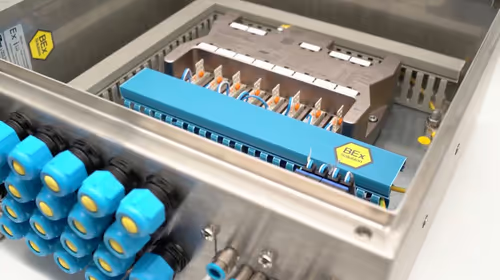
The BEx Remote IO modules, whether IP20 or IP67, are designed to be compact and combine very small dimensions with a high channel density. Take the BEx1 IP67 module as an example: this module can be mounted directly on the plant in Ex Zone 1 without an additional Ex enclosure. Dimensions (L x W x H): 214 x 206 x 115 mm. All data sheets, manuals and certificates are available in the download area.
Leading companies that trust us















Get in touch
Does your configuration require specific planning? Check the technical compatibility of your project with our expert.